Adrià MolinaRodríguez

PhD researcher at the Computer Vision Center, UAB. I build search engines for historical archives that are comprehensive, measurable and relational.

Fig. 1 — 2,113 photographs from Catalan public archives, one brick each, stacked by catalogued year. exact datedate rangeHover to retrieve · click to open
§01

Brachylogia

From the thesis introduction

Socrates asked Protagoras to cut up his answers into shorter pieces, to strip the rhetoric off his speech. Two and a half millennia later, we have not moved beyond that tension between discourse, truth and measure.

Search engines are increasingly being set aside, replaced by the rhetoric of large language models.

They privilege what sounds persuasive over what is true. Retrieval offers evidence, without the relationships between pieces of evidence.

Conversational interfaces suppress the sources a user will never consult, and with them, the user's own doubt.

A historical truth is only as precise as the sources retrieved.

§02

Three requirements

For archives, libraries & museums
i.

Comprehensive

Incorporate as many relevant sources as possible, to construct the most complete description of a historical phenomenon.

ii.

Measurable

Anchor every source to identifiable, verifiable fragments of information, so the contribution of each one can be tracked.

iii.

Relational

Natively support inter-relationality: let people explore grounded connections between sources, not just primary sources alone.

There is no foundation model for the past.

It is tempting to think nobody has trained one yet, that it is a matter of time and money. It is not: historical documentation, as a whole, inherently resists large-scale pattern recognition pre-training. What it needs is a proxy, a system that behaves foundationally across domains, languages and typologies while remaining narrow in scope.

  1. 01

    Visual diversity

    Born in a less communicated, less globalized world, historical documents exacerbate the differences between collections of similar domains.

  2. 02

    Annotation cost

    Collections are sparse and incomplete; expert knowledge is required even for foundational tasks such as reading text.

  3. 03

    Governance

    Heritage carries cultural significance. Centralizing it outside each archive's data governance is legally and ethically out of reach.

§03

Research questions

RQ1 — RQ4
RQ1

Can a system provide answers that are grounded and measurable, yet comprehensive with respect to a document collection?

Even when augmented with retrieved content, chatbots cannot count relationships, constrain literals such as dates or names, or account for the relevant content they never retrieved. I index photographs and documents through visual routines, graphs and ontologies instead.
RQ2

Is there such a thing as a foundational model for historical document analysis?

Building one looks like a chimera, yet practitioners still need an initial seed for zero-shot prediction or light fine-tuning. I study decentralized learning and model editing to bypass centralization while improving low-resource, out-of-domain reading.

RQ3

Is temporal information a proxy for the primary value of a document?

A date alone cannot index a specific fact, but temporality is entangled with the topics and styles of a period. It can serve as a proxy to relevant information from the preservation perspective.

RQ4

Are neural representations temporally coherent?

Should a late nineteenth-century car and a modern one share a representation? Time evolves in a continuum, so models should read historical data as a progressive evolution of features, not as isolated, well-defined clusters.

§04

Interactive papers

§05

Publications

via Google Scholar
Press /
§06

Curriculum

2019 — now
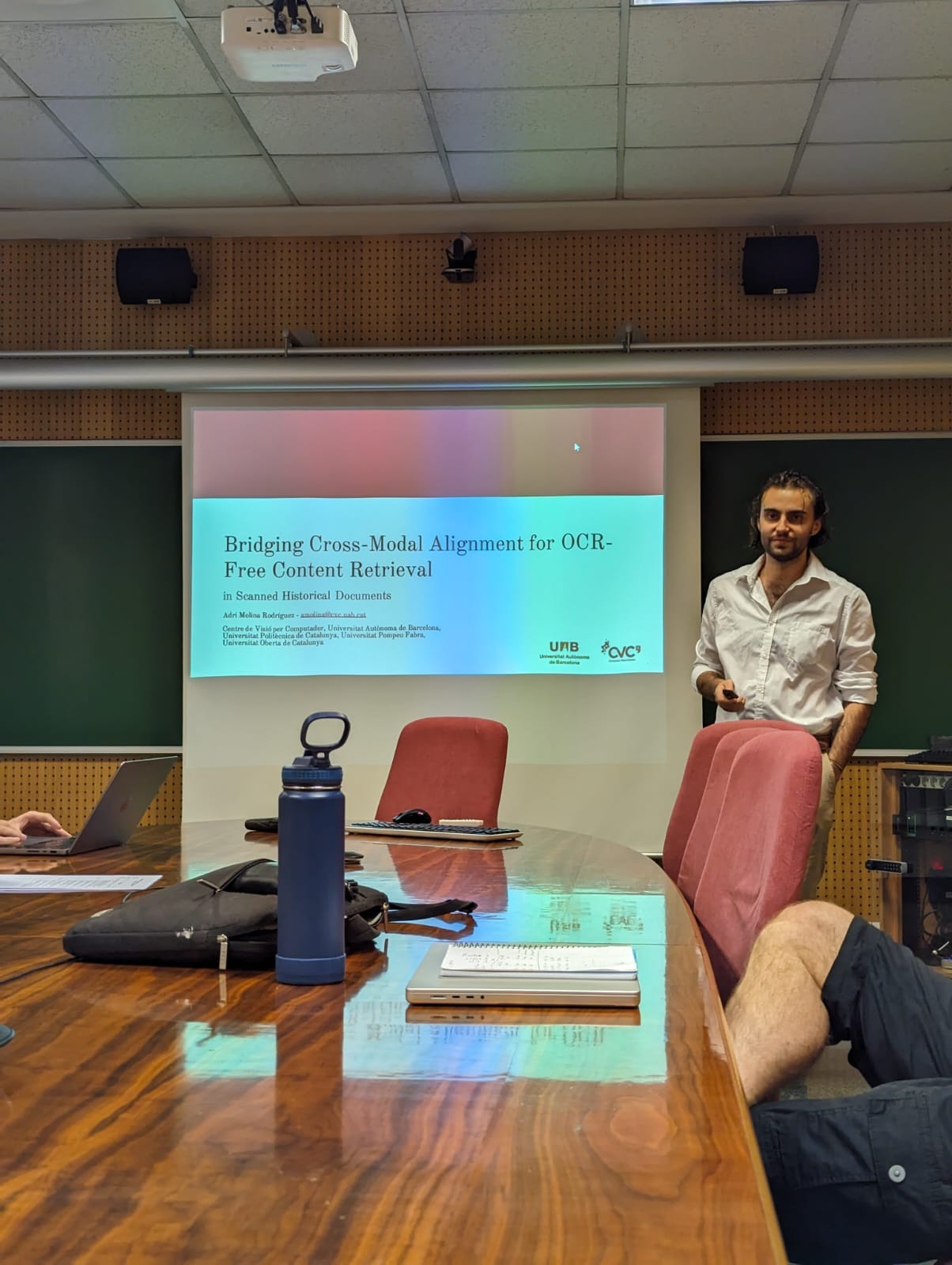
Adrià Molina Rodríguez presenting a master's thesis in a seminar room
Fig. 2 — Defending the master's thesis, 2023. Back when there was still light in my eyes.

Work

2023 — now

Predoctoral researcher (FPI)

Computer Vision Center · Universitat Autònoma de Barcelona

Indexing historical photographs and documents with factual data, within the project Graph Reasoning for Automatic Interpretation and Learning. In collaboration with the Xarxa d'Arxius Comarcals and the Centre d'Estudis Demogràfics.

2021 — 2023

Research engineer

Document Analysis Group, CVC

Applied research and proofs of concept in image analysis for archives, under the agreement with the Xarxa d'Arxius Comarcals.

2021

Research & development

BMAT · Charts

Metadata de-duplication for the music industry.

2021

Research engineer

CVC · FECYT

Science outreach: a (now defunct) Twitter bot that dated users' photographs.

2019 — 2020

Research assistant

CVC student grant

Retrieval through continuous approximations of discrete ranking functions.

Education

2023 — now

PhD in Computer Science

Universitat Autònoma de Barcelona · Computer Vision Center
2022 — 2023

MSc in Computer Vision

CVC-UAB · UPC · UPF · UOC
2018 — 2022

BSc in Data Engineering

Universitat Autònoma de Barcelona

Recognition & other

Award

2nd best paper, DAS 2024

Fetch-A-Set
Award

Best doctoral thesis proposal

International Conference on Document Analysis and Recognition
Venture

UrbView

Co-founder. Urban design analysis for building cities with a gender perspective.

Supervised work

P. Font

Conversational retrieval and knowledge modeling from historical documents

J. C. Montero

An agentic perspective on graph-based RAG

È. Sànchez

Catalan captioning of historical photography

A. Fernández

Question answering over legislative documents (BOE)

M. Serra

Word spotting for historical legislative documents

A. Fernández-Rascón

TerritoCAT, a game to annotate historical photographs of Catalonia

§07

Side projects

Built for fun & outreach
§08

Contact

Write, and doubt freely